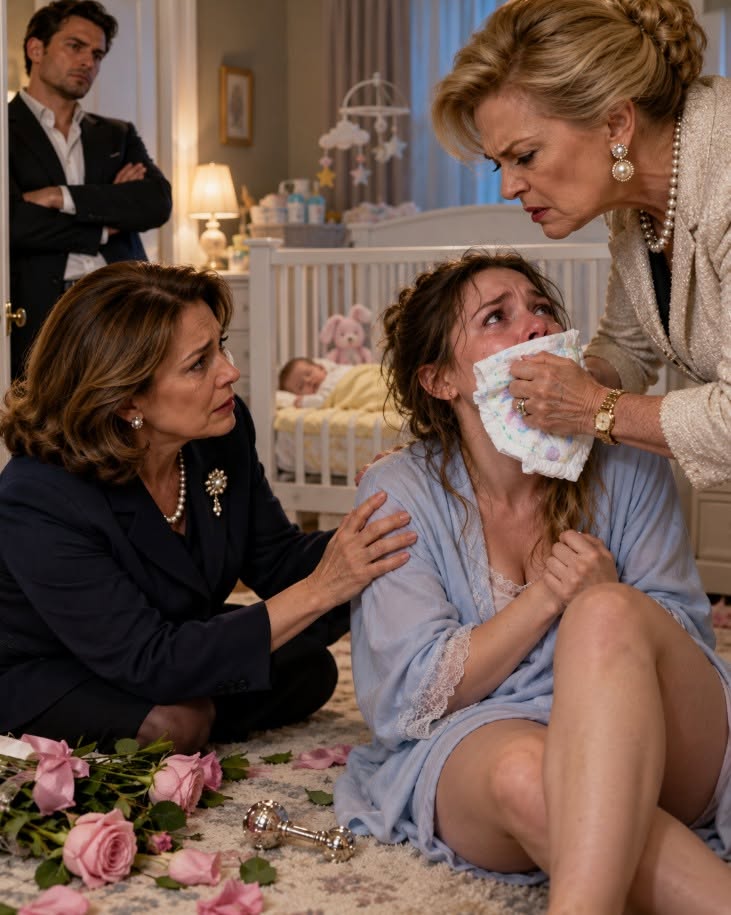
The Day I Found My Daughter Silenced in Her Baby’s Nursery, I Started Recording. By Midnight, the Whitmore Family Had Learned They Had Chosen the Wrong Mother to Threaten. The moment I stepped into my daughter’s nursery, I knew something was terribly wrong. It wasn’t my six-day-old granddaughter crying that stopped me. It was the sound of my daughter trying to breathe. Lily sat on the carpet beside the white crib, one hand pressed against the polished hardwood floor as if she needed it to keep from collapsing. She wore a pale blue robe. Her brown hair was damp at the temples. Her skin had the gray, exhausted color of someone whose body had been pushed past its limits. And over her mouth, Margaret Whitmore was pressing a disposable baby diaper. “Maybe now you’ll learn what babies actually need,” Margaret hissed. For one full second, I couldn’t move. Six days. My daughter had given birth six days earlier. The hospital bracelet was still around her wrist. Her pain medication sat beside the wipes on the changing table. A half-finished glass of water stood beside the rocking chair. And my son-in-law, Bradley Whitmore, was leaning against the nursery wall with his arms folded. Watching. He didn’t look horrified. He didn’t look shocked. He looked irritated. “Please,” Lily gasped when Margaret finally lowered the diaper. “I’m trying. She wouldn’t stop crying.” Bradley gave a cold laugh. “You can’t even care for a child.” Lily looked at him.

“My mother was right,” he continued. “You’re too soft.” The bouquet of pink roses in my hand hit the floor. So did the little silver rattle I had bought that morning. Margaret turned. For half a second, genuine fear flickered across her face. Then she smoothed it away. “Oh. Evelyn.” As if I had interrupted lunch. “You should have called before barging into our home.” “Our home?” I repeated. Bradley straightened immediately. “Mrs. Carter, this is just a misunderstanding.” I didn’t answer him. I crossed the room and knelt beside Lily. “Mom,” she whispered. Her voice nearly broke me. I touched her cheek. She grabbed my sleeve with both hands. Behind her, my granddaughter slept beneath a pale yellow blanket. Tiny fists curled near her cheeks. Perfect. Peaceful. And unaware that monsters did not always come through windows. Sometimes they wore pearls. Sometimes they wore tailored suits.
Sometimes they smiled in wedding photographs. Margaret sighed. “Lily is overwhelmed. We’re trying to help her.” “By holding something over her mouth?” “It was symbolic.” I stared at her. “Symbolic.” “She was hysterical.” “I was crying,” Lily whispered. Margaret snapped, “You were upsetting the baby.” “The baby was already crying!” Bradley’s voice cracked through the room. “Lily. Stop.” And my daughter went silent. Instantly. That frightened me more than anything. Lily had never been a woman who became quiet simply because a man ordered her to. At nine, she argued with an emergency-room doctor while he set her broken wrist. At seventeen, she stood up in class after a teacher humiliated a shy student. At twenty-nine, she married Bradley despite my concerns because, she told me, she knew her own mind. Now she looked at the floor. I became very calm. People often mistake calmness for weakness. They shouldn’t. I spent nearly four decades practicing corporate law before retirement. I had watched executives lie under oath, watched wealthy families destroy each other over trusts, and watched men with more money than judgment ruin themselves because they believed intimidation was the same thing as power.